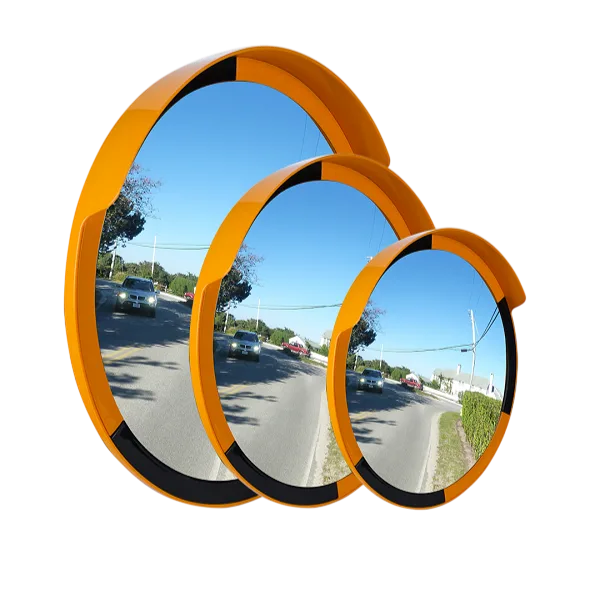
Road mirror
The road mirror is a safety device that enlarges the visual field at intersections, at exits from the courtyards, in parking lots and in areas with dead angles. Choosing the right model and fitting it correctly contributes to accident prevention and traffic fluidisation.
In short: convex mirrors for exterior, mirrors for interior, polycarbonate or acrylic, chosen after size, location and angle.
Do you need help choosing?
Tell us what you need and we'll send you the offer on the same working day.
The size, location, material, catch system and angle of visibility shall be the key to the choice. Convex mirrors for outdoors are mounted at unseen intersections and at exits from the courtyards and in commercial parks, warehouses, factories and logistics centres reduce the risk of collisions between machines and personnel. Resistant material and proper assembly ensure efficient use, both in traffic and in private spaces.
The road mirror improves visibility in areas with dead angles. Discover the available types, advantages and choice criteria.
Road mirror is a safety device that increases the visual field at intersections, exits from the courtyards, parking lots and areas with reduced visibility. Choosing the right model and fitting it correctly contributes to accident prevention and traffic fluidisation.
Road mirror – Complete guide for correct choice, use and assembly
Introduction
Road mirror is one of the most effective solutions for increasing visibility in areas where the field of vision is limited. Whether it is mounted in a dangerous intersection, at the exit from a yard, in a parking lot or in an industrial area, it reduces the risk of accidents and facilitates safe maneuvers.
In this guide you will find out what is a road mirror, how it works, what types there are, where it mounts and how you choose the right option depending on the location and the conditions of use. You will also discover practical recommendations, frequent mistakes to avoid and important criteria for an effective long-term investment.
What is a road mirror?
Road mirror is an equipment designed to improve visibility in areas where obstacles prevent traffic or pedestrian sighting.
It provides a wide viewing angle and allows drivers to observe vehicles, bicycles or pedestrians approaching in time.
It is commonly used in:
- low visibility intersections;
- exits from the courtyards and garages;
- public and private parking;
- logistics centre;
- industrial halo;
- deposits;
- private roads;
- gassing;
- commercial spaces.
How does a road mirror work?
The principle is simple: the convex surface reflects a panoramic image, extending the user's visual field.
Compared to a flat mirror, a convex mirror allows a much larger surface to be observed, even if the reflected objects appear slightly smaller.
For maximum efficiency it is important that the mirror is:
- mounted at the correct height;
- specifically oriented towards the area of interest;
- regularly cleaned;
- protected against damage.
Why is it important?
Reduced visibility is one of the main causes of traffic incidents and industrial spaces.
Installation of a road mirrors contribute to:
- reduction of dead points;
- prevention of collisions;
- increasing pedestrian safety;
- facilitation of exit manoeuvres;
- reducing the costs of accidents.
In industrial environments, mirrors contribute to the protection of employees and the organisation of a safer traffic flow.
Benefits and Benefits
Using a road mirror offers many practical benefits.
Extended visibility
It allows traffic to be observed in directions that are hard to reach visually.
Increasing safety
Reduces the risk of accidents at intersections or exits without visibility.
Quick assembly
Most models can be installed on existing posts, walls or other structures.
Weather resistance
Modern models are made of UV-resistant polycarbonate or acrylic, rain and extreme temperatures.
Reduced cost compared to benefits
The investment is small in relation to the value of accident prevention.
Types and variants of road mirrors
There are several categories, each intended for a certain type of use.
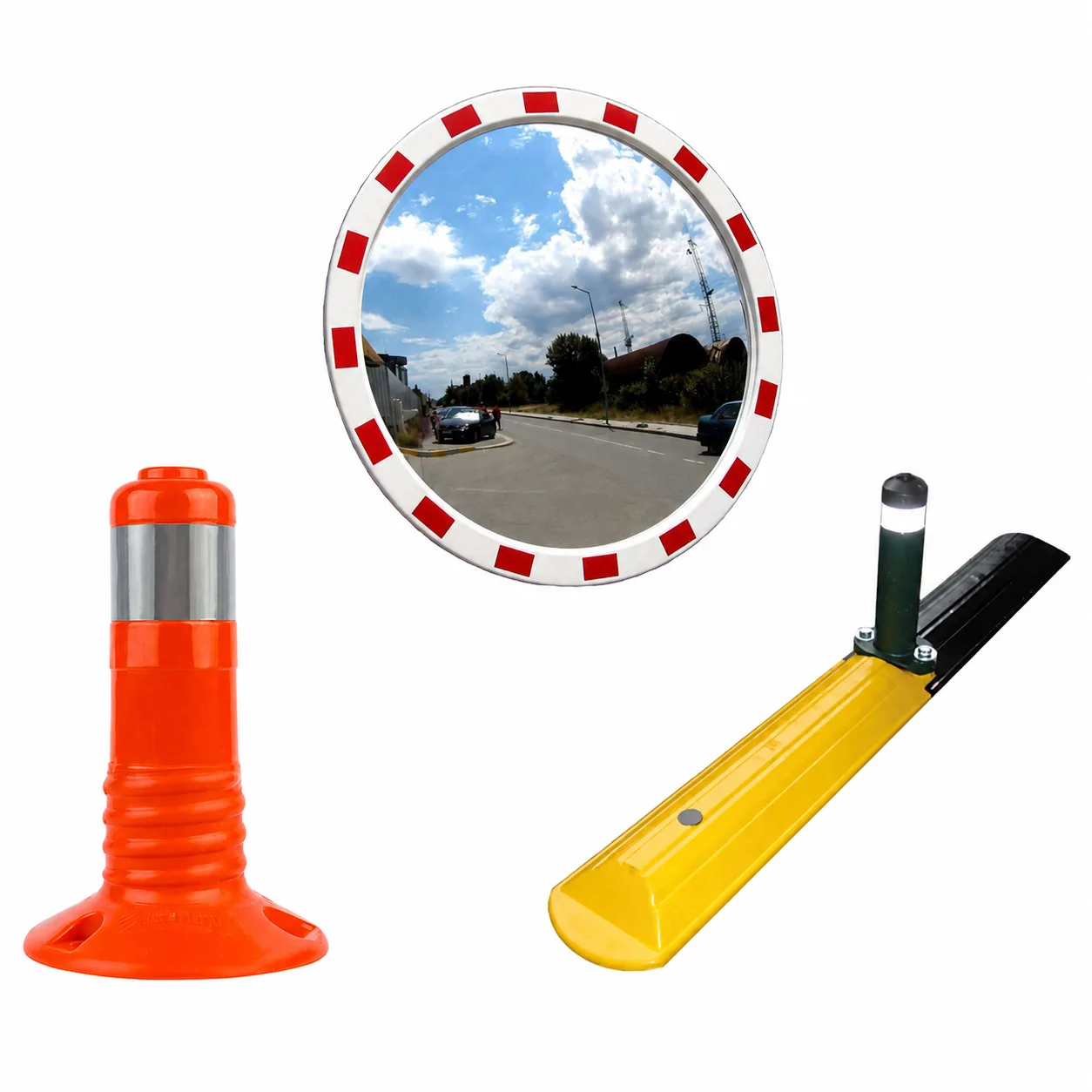
Convex mirrors for outdoors
- UV resistant;
- reflectorising surface;
- protection against weather;
- ideal for roads and parking.
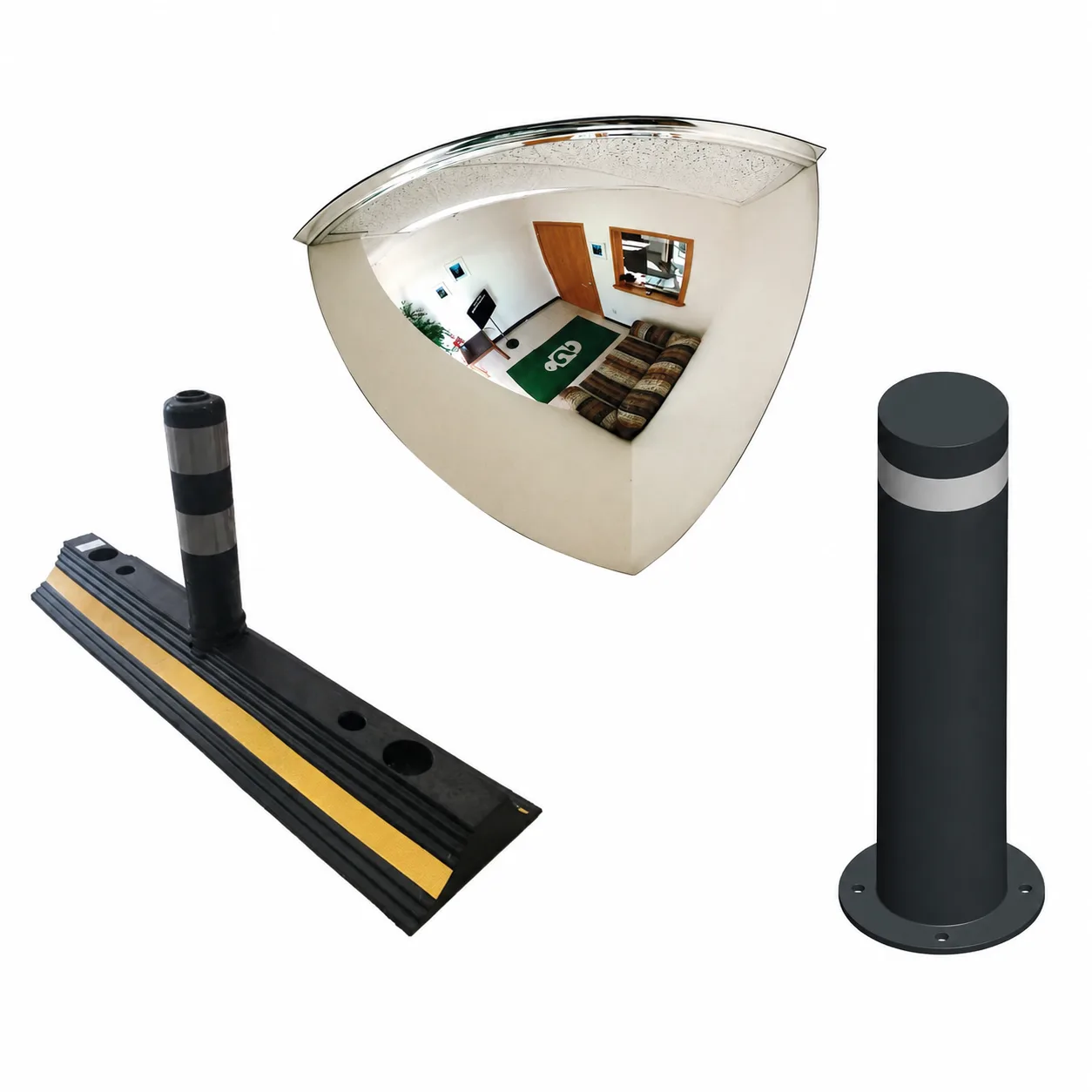
Interior mirrors
For use in:
- deposits;
- hale;
- supermarkets;
- logistics center.
Polycarbonate mirrors
- very impact-resistant;
- recommended for intensive traffic;
- long lifespan.
Acrylic mirrors
- very clear picture;
- reduced weight;
- suitable for areas at low risk of vandalism.
Differences and comparisons
| Characteristic | Polycarbonate | Acrylic |
|---|---|---|
| Impact resistance | Very large | Average |
| Image Clarity | Very good | Excellent |
| Weight | Decrease | Very low |
| Resistance to vandalism | Lifted | Average |
| Recommended use | Outside | Protected interior and exterior |
Common errors
Even the best road mirror can become ineffective if used incorrectly.
The most common mistakes are:
- choosing a diameter too small;
- the assembly at the wrong height;
- incorrect orientation;
- lack of maintenance;
- the location behind the vegetation;
- use of an exterior interior model.
How do you choose a road mirror correctly?
Before purchasing, it is recommended that you consider some important aspects.
Size
The greater the observation distance, the greater the diameter of the mirror.
Location
The exterior requires models resistant to:
- rain;
- ice cream;
- UV radiation;
- vânt.
Material
Polycarbonate is recommended for intense traffic.
Catching system
Check if the support allows multiple settings and secure fixing.
Visibility angle
The model must cover the entire risk area.
Professional advice
Specialists recommend:
- periodic verification of the catch system;
- regular cleaning of the surface;
- avoiding mounting in the right of strong light sources;
- the use of dimensions adapted to the observation distance;
- replacement of damaged mirrors immediately.
Real example of use
Commercial parks
Reduce the risk of collisions between cars and pedestrians.
Logistics Centre
It helps the dock operators observe cross-border traffic.
Outflows from the courts
Permit accesul în trafic în condiții de siguranță.
Intersections without visibility
Complete existing signalling measures.
Industrial units
Contributes to reducing incidents between machines and staff.
Recommendations
For optimal results:
- choose the size according to the distance of visibility;
- opt for impact-resistant and UV-resistant materials;
- verify that the product is intended for external use;
- Mount the mirror so that the image covers the entire risk area;
- carry out periodic checks to maintain efficiency and safety.
Conclusion
Road mirror is a simple, efficient and accessible solution to improve visibility and prevent accidents in many types of spaces. Choosing the right model, together with proper assembly and minimal maintenance, can make the difference between a safe operation and a costly incident. Regardless of whether it is used in a parking lot, in an industrial area or when leaving a property, a road mirror contributes to increased safety for all traffic participants.
BENEFICII COMERCIALE
- Increases visibility in areas with dead angles.
- Reduces the risk of accidents and material damage.
- It improves the safety of pedestrians and drivers.
- Economic solution to prevent incidents.
- Quick assembly on posts or walls.
- Impact-resistant materials and difficult weather conditions.
- High operating time with minimum maintenance.
- Suitable for residential, commercial and industrial use.
- Available in different sizes and configurations.
- Contributing to the efficient organisation of traffic.
FAQ
1. What is a road mirror?
It is a convex mirror that increases the field of view in areas with reduced visibility and helps prevent accidents.
2. Where's a road mirror?
In intersections, parking lots, exits from the courtyards, warehouses, industrial halls and private roads.
3. What material is more resistant?
Polycarbonate provides superior impact resistance and is recommended for outdoor use.
4. How do I choose the right size?
The diameter shall be determined according to the observation distance and the area to be monitored.
5. Is there a need for maintenance?
Yeah. Regular cleaning and checking of the gripping system shall maintain the efficiency of the mirror.
6. Can a road mirror replace the road signs?
No, no. It complements signalling measures and improves visibility, but does not replace indicators or traffic rules.
7. What is the lifespan of a road mirror?
Depending on the material and operating conditions, a quality mirror can function efficiently for many years.
8. Are they suitable for industrial spaces as well?
Yeah. They are frequently used in warehouses, factories and logistics centres to reduce the risk of collisions between machines and staff.
Road mirror improves visibility in areas at risk and contributes to accident prevention. Choosing the right size, durable material and correct assembly ensures efficient use in both traffic and parking, commercial spaces or industrial areas.