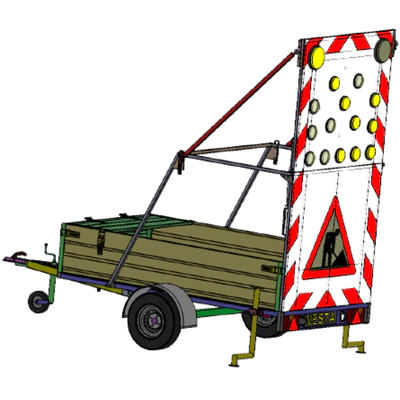
What signalling trailers are and what they use
Signalling trailers are mobile platforms specially designed to transport and display traffic warning and steering systems. They combine a towable chassis with visual equipment such as LED panels, road signs, beacons or intermittent lights.
Unlike fixed signaling, these solutions are mobile, quick to install and can be moved depending on the evolution of work or situation in the field.
They are used for:
- temporary road works
- accidents or emergency operations
- temporary traffic diversions
- public events
- hazardous areas or temporary restrictions
Where the signalling trailers are used
Road works and infrastructure
In road construction sites, mobile signalling is essential for protecting workers and informing drivers. Trailers can be located quickly before the work area and moved as the project progresses.
Emergency assistance
The intervention teams shall use these platforms for rapid warning of traffic in the event of accidents, landslides or other unforeseen situations.
Events and temporary restrictions
At sporting events, festivals or urban works, trailers help drive the flow of vehicles and pedestrians.
How a signal trailer works
At the base, it is a trailer approved for public roads, equipped with:
- power supply system (batteries, solar panels or generator)
- LED panels or reflectors
- controller for displaying messages
- Stability and safety systems
The operator may modify the messages or signals according to the situation, manual or remote control.
Why Mobile Signalling Is Important
Proper signaling reduces the risk of accidents, prevents traffic jams and protects work teams.
The main benefits include:
- increasing the visibility of warnings
- faster reactions of drivers
- adaptability to changing conditions
- compliance with road regulations
Real benefits for users
For authorities and construction companies
- rapid implementation without permanent infrastructure
- reduced costs compared to fixed signaling
- maximum flexibility
For drivers
- clear information in real time
- reducing stress and confusion
- increased safety
Type of signalling trailer
Trailers with variable message panels (VMS)
Display dynamic text and symbols for warning and information.
Trailers with classic road signs
It shall carry reflective signs or swivel mechanisms for restrictions and deviations.
LED directional arrow trailers
Used to direct traffic bands in work areas.
Self-contained trailers with solar panels
Independent energy solutions for long-term location.
Differences between available variants
The main differences relate to:
- type of display (LED, reflector, mechanical)
- energy source
- dimensions and portability
- compliance with road standards
- control and connectivity options
How to choose the right signal trailer
Analyze the usage scenario
- temporary or permanent
- intense or reduced traffic
- urban or extra-urban conditions
Check approvals
It is essential that the trailer and equipment comply with local and European road rules.
Energy autonomy
For isolated locations, solar panels and batteries are critical.
Visibility and luminosity
LEDs must be visible day and night under any weather conditions.
Common mistakes and how to avoid them
- choosing a trailer without road certification
- Underestimation of energy autonomy
- incorrect location of the risk area
- Lack of maintenance of light systems
Professional recommendations
- Plan signaling before work begins
- Use simple and easy to understand messages
- Test visibility from different angles and distances
- Updates messages in real time for maximum efficiency
Maintenance and good practice
Periodic checks
- batteries and solar system
- LED operation
- Mechanical stability
Cleaning and protection
Dust and dirt can reduce the visibility of the displays, and corrosion can affect the structure.
Software update
For trailers with digital panels, the firmware shall be kept up to date for stability and security.
Conclusion
Signalling trailers are essential solutions for managing traffic under dynamic conditions. They offer flexibility, safety and control, being indispensable in infrastructure, interventions and events. The right choice depends on context, autonomy and technical compliance, and professional use can make the difference between a safe project and a risky one.