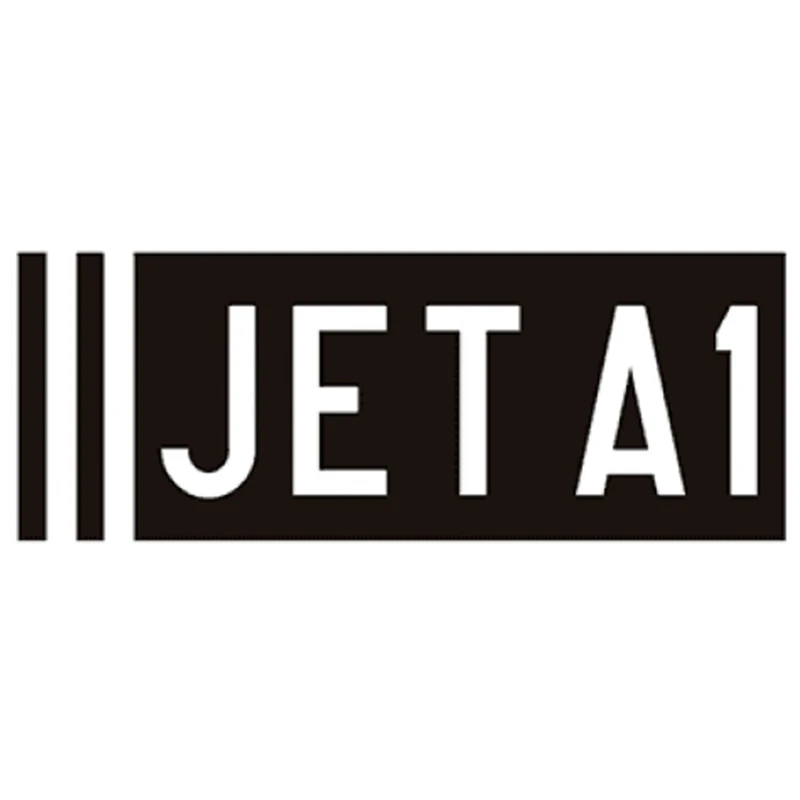
Self-adhesive "JET A1" for air transport of fuel, non-reflective, 400x150 mm is a label specially designed for the clear and safe identification of fuel Jet A‐1, used in transport, storage and handling operations of this type of aviation kerosene. In the aviation industry, fuel labels are not just visual elements – they are critical instruments of compliance, safety and operational communication.
This description provides a complete picture of the product: from its functionality and benefits for aircraft maintenance professionals and airport operations to technical details, good application practices and compliance with international visual identification standards.
What Jet A‐1 is and why labels matter
Jet A‐1 is a type of aviation fuel based on kerosen, widely used in commercial and transport aircraft turbines. It has specific criticisms such as:
- maximum freezing point of −47 °C and ignition point ≥ 38 °C according to international standards such as ASTM D1655 and DEF STAN 91-91;
- use in global civil operations, making it the standard fuel in most of the world except SUA (where Jet A is used).
The labels for Jet A‐1 are not decorative – they serve at immediate identification of fuel type, reducing the risk of mismixing, facilitating maintenance operations and complying with the visual requirements of the ground supply and safety manuals.
Commercial and operational applications
Identification in road and airport transport
In aviation fuel logistics, JET A1 sticker is used on:
- containere și cisternede transport al combustibilului
- specialised ADR vehicles
- Bands and handling areas
- ground distribution equipment
- Fuel storage and storage areas
This sticker helps operators to quickly identify that the vehicle or container transports a specific product – fuel Jet A‐1, thus ensuring maximum safety in handling.
Material and sustainability
The sticker is non-reelectorizing, which makes it ideal for:
- uses inside or in spaces where reflectivity is not required
- storage and handling where direct light is not the main factor
- Standard Logistic Marking Applications
It is made of a robust adhesive material designed to withstand:
✔ contact with the industrial environment
✔ handling during loading and unloading
✔ Moderate exposure to petroleum substances
✔ variations in operating temperature
Moreover, the sticker material is designed to adhere well to flat, metallic or composite surfaces, providing a clear permanent visibility.
Design, Visibility and Visual UX
The sticker has a simple and clear design:
Text ‘JET A1 — easy to read, in strong contrast
Size 400×150 mm — large enough to be observed from a distance
appropriate format for vehicles, containers and handling areas
This dimension is optimized for visibility in a dynamic environment such as an airport or a fuel logistics area.
Compliance with good practices and standards
Although the rail product is not a certified device (such as ADR equipment), its use respects good international practice Visual identification and fuel safety:
✔ meet the most common marking requirements for special fuels
✔ allows rapid identification in operational procedures
✔ contributes to compliance with safety instructions in fuel handling
✔ Supports compliance with airport operational manuals
Key benefits for companies and professionals
Safety and reduction of errors
Correct labelling significantly reduces the risk of:
Wrong aircraft feed
Loading errors in transport
Accidents and incidents at handling
Compared to generic labels
Unlike standard identification labels, sticker JET A1 offers:
✔ Optimum format for vehicles and containers
✔ clear text, no unnecessary decorative elements
✔ compatibility with industrial workflows
✔ standard industrial dimension 400×150 mm
Example of practical use
Imagine:
An aviation tank entering the power station
Clear markings of the type of fuel on the side and in the access area
The operation team that can immediately identify the fuel without any doubt
This level of clarity reduces operating time, increases efficiency and ensures maximum safety.
Specific applications by type of equipment
ADR vehicles and trailers
The sticker fits perfectly on:
- fuel transport trailer
- tank or container fixed
- Pump holders and related equipment
- Massive Logistic Areas
It is designed to maximize visibility and readability without reflecting.
How the sticker is properly mounted
- Clean the surface with a neutral solvent
- Make sure there are no impurities or particles
- Apply the label at the recommended temperature (15–25 °C)
- Uniform press for perfect grip
Maintenance and longevity
The sticker can be cleaned with neutral solutions without damaging the text. Avoid contact with corrosive or abrasive substances.
Case studies in industry
Example 1: An air handling company in Europe reduced fuel errors by 98% after implementing standardised fuel labels.
Example 2: A logistic fleet replaced all generic labels with specialized stickers and noted an improvement in ground operating times.
Commercial benefits
- Rapid identification of fuel type
- Increases fuel handling safety
- Reduce operational errors
- Industrial design for high visibility
- Optimum size for vehicles and equipment
- Compatible with intensive logistic flows
- Easy application, simple maintenance
FAQ – Frequently Asked Questions
1. What is JET A1 sticker?
It is a non-reflective label identifying Jet A-1 fuel for industrial transport and handling.
2. Why is it important to use this label?
For clear fuel identification, reduction of errors and compliance with operational standards.
3. On which surfaces can it be applied?
On metal, plastic or other flat surfaces used in vehicles and fuel containers.
4. Is it reflective?
No — is non-reflective, designed for applications where light reflection is not required.
5. What is the exact size?
400×150 mm, ideal for visibility in industrial and airport environments.